Maybe.
The “Over Temperature” is definitely a clue, and the fan is a definite possibility.
But first we should talk about … dust bunnies.
Become a Patron of Ask Leo! and go ad-free!
Dust bunnies
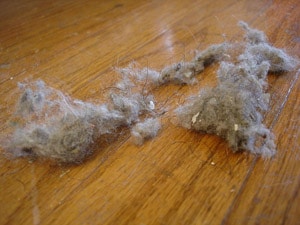
For those who might not be familiar with the term, “dust bunnies” are clumps of dust and debris that form in and around computers, furniture, and other areas that aren’t cleaned regularly.
We might not think much of them, and indeed, in places they exist it’s typically because someone isn’t thinking about them very often.
But here’s the dirty (no pun intended) secret: dust bunnies can kill computers.
Computer fans and dust
As you’ve noted, your computer has at least one fan, and possibly more. The computer’s components generate heat, and the purpose of the fan(s) is to keep the computer cooler by pushing warm air out and pulling cooler air in.
The problem is the “pulling air in” part also pulls in dust and dirt. This detritus accumulates into clumps that, if left unchecked, eventually block the vents through which the air is supposed to move. This can happen both outside your computer, where it might be visible, as well as inside, where it’s not.
The result is your fans might well be running but can’t do their job because the airflow is blocked. In fact, the fan motors themselves end up adding even more heat to the mix.
As a result, when things get too hot, your computer overheats and crashes.
Cleanliness is cool
As you might imagine, the solution is fairly clear: keep the area around your computer clean and clear, and periodically check for accumulations of dust and dirt in and around your computer.
More specifically:
- Make sure there is room around your computer, particularly around the vents, for air to flow. This might mean moving your computer away from objects that block the airflow.
- If you can, put your computer in a cooler part of the room, or near a natural air flow.
- Vacuum around your computer, particularly behind it, on a regular basis. How often depends on how quickly dust accumulates in your particular location. If you’re seeing clumps, as pictured, you’ve waited too long.
Recovering from a bunny infestation
If you’re already in the “covered with dust bunnies” stage, shut down and unplug your computer, open the case, and use a can of compressed air to carefully blow the dust out of your computer. Pay attention to the location of the fans and any accumulations of dust and dirt. You might have a vacuum running nearby to capture the dust as it flies out of your machine.
In the past, I’ve recommended using a brush attachment on your vacuum cleaner and directly vacuuming the interior of your computer. The problem with this approach is that the movement of air around a large electrical device such as a vacuum cleaner often generates static electricity, which, if it discharges in the wrong place, could damage your computer. You’ll be safer with that can of compressed air and the vacuum nearby (but not in contact with) your computer. (Small battery powered vacuums specifically designed for cleaning your computer are generally safe to use, though often under-powered.)
To get back to your question, yes, it could be the fan. While you have your computer open, after you’ve cleaned it, plug it back in again and make sure those fans are actually running. If not, they may have been damaged by getting clogged with dirt, and need to be replaced.
These bunnies aren’t cute
Dust and dirt inside a machine is easy to overlook. I’ve personally seen some amazingly overlooked computers in my day.
The good news is, it’s an easy thing to stay on top of, and it’s worth it. There are enough other things that can go wrong. We don’t need killer dust bunnies to add to our problems.
Do this
Subscribe to Confident Computing! Less frustration and more confidence, solutions, answers, and tips in your inbox every week.
I'll see you there!


Case in point: I make it a habit to regularly dust the inside of my computer–once every maybe 3 to 6 months. This past Saturday, I did just this. And, through a temperature monitoring software I use, I noticed the temperature drop almost 15 degrees (F). You might not get this drastic of a difference, though. I actually take my video card out, take my heat sink off, re-add thermal gel to the processor. All in all, I think it’s worth it though.
I had this problem. It would have never occurred to me that it could be bad RAM, but I was lucky enough to find an article about it and, sure enough, after I replaced the memory all was fine. It was an inexpensive and instantaneous fix.
“My computer has started to shut down randomly, could it be the fan?”:
Another way of preventing dust build up is use your vacume cleaner nozzle ( Plastic ) I must add to clean and suck out all air holes in Pc Case also inside too this keeps most fans runing smoothly. From Danny
About my comment above about bad RAM… in my case, I was not getting “over temperature” notification , so it is more likely dust buildup.
You know, we all to often take our computers for granted, they are like anything else, … if you look after them, “they” will look after you!! Thanks for pointing out how important it is , to keep our computers”clean”!
Did you know, the dust in your computer is like 85% dead skin. Think about it…. :)
It’s always a joy for me to fix and clean other people’s old, mothball filled systems. You would think they never knew how to use a vacuum. Compressed cans of air ftw!
Two things: 1. The dust can cause a lot of noise, too, depending on how the fan is structured. 2. You forgot to mention that one doesn’t have to “lose all” when the computer shuts down. Any old hand will tell you he saves what he is doing every few minutes, and sometimes every few seconds. I automatically do a CTRL-S after virtually every editing change, and every paragraph input. After “losing all” once, there’s really no excuse for getting caught a second time. Whatever the program you’re using, just think, “Would I want to have to type all this in again?” When you do that, you’ll automatically do a “save” often.
26-Nov-2008
I’ve found that improper cleaning can cause more harm than good. Regarding using a vacuum to clean the interior of your PC, this can be dangerous since static electricity can be generated by the vacuum and cause damage to PC components. A bit more troublesome but safer way to clean the interior of a PC is with short bursts of compressed air making sure that the can is not shaken or that moisture is expelled from the can while cleaning.
26-Nov-2008
But what if the whole dust bunnies thing does not apply and there are no messages? The fan(s) seem OK and temperature does not seem to be the issue due to the randomness of the problem. Could it be software related?
26-Nov-2008
Leo.. I’m glad that you presented this article on “Dust Bunnies” There are many out there that will benefit from the info. Any time I do a major clean up of my PC I open the power supply and clean it. I uncouple all my connections inside my PC and reconnect them back. (this creates a good connection)(do one connection then reconnect, then go on to the next connection, this way there are no errors).. I clean out the heat-sink using a small brush and a piece of cardboard. I remove my audio and video cards and wipe off the contacts on them with a soft lint free cloth and brush out the slot where they came from. Remove the memory sticks (RAM) and wipe of the contacts with a soft cloth. It is also essential to buy a couple of cans of compressed air to blow out the dust from the inside of the PC.. Ensure that the components on the motherboard are free of dust as well. Note.. BE very careful of static electricity that may come off you when handling any of these components… it could damage what you are handling. I perform these tasks at a slow and thoughtful pace. I’d suggest that you do a (Google search) on How to clean the inside of a computer. Thank you Leo for all the articles I receive from you each week and the comments from your readers.
An often forgotten aspec of computing; keeping it cool. I saw a reference in the replies to use compressed air. I would like to add to this “with caution” as a full can can often dispense the air with in it in it’s liquid form and damage components. I rebuild old computers to give away to school kids and one of my most used tools is a small cylindrical two-handed pump used to blow up those long balloons that make animal shapes, it cost about $4 from a toy shop and with it’s pointed nozzle I can get right into the processors vents without removing the heat sink.
Another tip for users: IF you have to place your CPU on the floor, put it on a small box. Just getting it 6″ off the floor makes a lot of difference as to how much dust is sucked in.
Pay particular attention to the heatsink blades mounted on top of the CPU and on top of which the system fan is mounted. Dust often gets clogged between the blades and is difficult to see from the outside. I usually need to carefully remove the fan to clean it with a thin blade. If you otherwise clean your PC but still get overheating errors then this might be your problem.
Occasionally the cause can be hardware. About 15 years ago I had a similar problem; I don’t remember if the Pc shut down or complained of a memory error. The PC supplier eventually found a pin bent over when he removed the CPU!
Additional reason for shutdown may be a problem with the energy supply which comes in a “block” with several plugs (wires) to connect to hard drive, cd/dvd drive etc. If that one is failing, pc will shut down on regularly and unexpected (no warning) moments and sometimes not start at all, even after hitting the power button on-off, sometimes until you wait for e.g. 30 minutes or 1 hour.
So yes, first possible cause of the shutdown is that the fans do not properly work, whatever the reason may be (dust, not powerful enough, bad power contact etc.). The second one is the energy supplier itself.
Also software failure is a possible cause, though hardware not functioning, the most probable.
You mean the power supply? I had the shutdown problem. Vacuum the fans take out the power supply and vacuum underneath fan, clean filters and turn off PC, leave it for 15 minutes. Have airduster ready, turn pc on and blast processor fan. Close your eyes and mouth, Bend your knees and bring it arouuuuund town. should be good for another 6 months…. Then repeat .
I have a dedicated computer for security with several cameras. I have had many many warnings of system overheat. Over the weekend sometimes I found the computer shut down on monday and had to reboot it. There were no dust bunnies and I cut a hole in the side of the case and installed a 6 inch 220 volt fan. The problem continued for about a year then it started failing every hour. The FIX was to replace the 1.2 year old power supply. Craziest thing I ever saw. But its been working now for 4 years without a hitch.
Strange, the power supply does not normally gradually go. The power supply sucks in air and obviously dust and fluff. The grills on the power supply might not be big enough for dirty Big Fluffy rabbits to escape, which would lead to shut-down through overheating.
Vacuming can be dangerous.
While cleaning the keyboard of my notebook I was using the brush attachment on the vacum cleaner hose to clean the keyboard. This worked good. So I thought using the hose attachment without the brush would work even better. It sucked three keys off the keyboard. Luckily I had just replaced the dust bag so I found all the parts to the keys. But it was a real hassle getting the keys back together.
Fred Langa, on one of his newsletters had a really good article on cleaning computers, with tips and dangers to watch out for.
I’ve also seen the blades of a cooling fan physically blocked by a wire inside the case. With more and more elements crammed inside, many of which have multiple wires running to and from them, it’s very important to close the case carefully and then make sure the fans are operating properly. A high-frequency clicking sound can also be a warning that a wire is starting to brush against a rotating blade. Not only can this cause over-heating, but there is a real possibility of an eventual short circuit if the insulation is completely worn off the offending wire.
Another possible cause is the motherboard itself. There is a temperature sensor on the board under the processor. If that sensor has failed and is indicating an extremely high temp, the board will shutdown. This is usually a surface mounted, non-replaceable component. The fix would be a new motherboard.
To clean the inside of my computer, I simply use a drinking straw with the bottom taped (with electricians tape) inside of the edge attachment on my vacuum cleaner.
Just wrap the tape gently around the straw until all the suction is coming from within the straw only. When finished, just peel the tape off along with the straw and throw it away.
This makes getting into the fan crevices so much easier and insures that I don’t accidentally ram my hardware components with the hard vacuum attachments.
Of course there are are micro attachments that you can also buy, but this method is cheap and works well enough for me.
re: oveheating and cleaning…would it be wise to install a fan running at low speed a few feet away from the unit?
03-Dec-2008
Just one thought from me.
SAVE your work about every 15 minutes to the Hard Drive so if something goes wrong all you have lost is 15 minutes of your work.
Besides the fan being free of debris and working properly, another culprit to check is the Thermal grease between the processor and heat sink. It is a gray gel-type liquid deisgned to help “pull” heat away from the processor. Remove the heat sink and clean the bottom of the heat sink and top of the processor gently with a small amount of rubbing alcohol on a rag or paper towel, then apply a small bit of thermal grease and reseat the heatsink. Obviously, remove the power and battery brfore you do this, there is no need to remove the processor if you are careful…
Hey guys! M also facing similar kind of problem with my PC. My PC gets off automatically at any time..I called a computer expert and he suggested me to replace SMPS(power supply switch) but it didn’t helped me..Some times my PC work well and works for hours n some time it gets off(not shut down, it gets off) frequently…what could be the probable reason for that?
Does were you place you computer contribute to this. When i put my computer to convert a movie for me, it shuts down after a while in to the conversion. This happens when i place my laptop on a ‘wooden’ surface. But this doesn’t occur when i place it on a glass surface.
09-Oct-2011
@Jonathan
That seems very likely as the glass surface would be a lot cooler.
Hi Leo,
I always enjoy your articles. This one served as a reminder and prompt to do what I should have done 6 months ago.
It is interesting to see the care and cautions posted by your readers. For the past 18 plus years I clean my computer by using an air hose connected to my air compressor and having a trigger controlled nozzle. I use my finger to keep fan blades from spinning too fast. I use short bursts into the power supply so as to keep the enclosed fans from spinning to fast.
The computer gets clean and in all these years I’ve never had any problem.
In 1958 I was an electronics technician aboard a naval destroyer. In the shipyard for our maintenance we cleaned our electronic equipment using a paint brush to scrub the surfaces with a water soluble cleanser and then using a hose sprayed water to rinse the circuit boards and components off. Then air hoses to blow the surfaces dry. I should add that before starting all potentiometers were first removed to keep water from getting in them.
( I don’t use this method for my computers tho. :-) )
Why not just drive through a car wash with your computer in a convertible with the top down :-)
Either this site or Bob Rankin cautioned that homemade canned air may carry dirt, but I never had any problems, anyway. At 100 PSI, My refillable air can just wasn’t that powerful or the Re air. Nobody is mentioning static discharge. Please ground yourself with a grounding strap.
My computer started to do the same a while back. It started to shut down, reboot or fail to boot or go into recovery to scan the system for errors. Turned out my Hard Drive was getting ready to fry. So, got a new hard drive, installed it, problem solved. Real pain having to reload everything from backups. I say backups because I don’t trust any one source as a back up for ALL of my files, pic, videos. I keep one backup online in a secure site and several others on flash drives and DVDs. The old saying, Don’t put all your eggs in one basket was good advice. Esp when it comes to digital storage devices. I have had many Flash Drives and Memory sticks go corrupt as well as CDs and DVDs. I pay close to $100 annually for a secure site 2TB to store my important files in a vault. Well worth the money should the hard drive fry or the digital backups go corrupt or worse still, get destroyed in a fire. Insurance can’t replace photos and important documents. So, if the problem with overheating is not dust bunnies, run a stress test on the hard drive. And do an image backup just in case. If the hard drive is making weird noises, Time to replace it. Thanks Leo for the informative articles. Between your articles and Bob Rankin’s I have garnered a great amount of computer knowledge and solved many problems.
Don’t put all of your eggs in one basket in terms of backup doesn’t mean having different files on different storage media. It means having more than one copy of that same backup. If you’d had a system image backup, you could have restored the entire system in a couple of hours and you can leave the whole process unattended. I have two attached hard drives and use Macrium Reflect to back up to one and EaseUS Todo to back up to the other. I use both programs mainly for the purpose of being able to answer questions about both programs. You can just as well perform a simple copy of the backup files to another drive. Additionally I keep all of my personal files in my OneDrive folder (Dropbox or which ever service you are using would work just as well).
Is the reason stored in some sort of log, This happened a few days ago, I meant to blow the dust out, but forgot the following day. Anyone know how to blow dust out if an ALL in one Mac(My Mothers). The web says that bad RAM(Random Access Memory) can also cause it to shut down with out warning
actually mine was a restart, not a shutdown
Actually many, many, MANY things can cause a random shutdown – dust and overheating is what I see as most common. (And, no, its not always logged — I’d even say typically it’s not.)
The article primarily addresses desktop computers that can be disassembled (i.e. remove covers & get to components for cleaning). When I had desktops, I followed Leo’s advice & cleaned my computers regularly. Now my wife & I both have laptops where the only accessibility is the small cooling port where the small internal fan draws air. i use a vacuum crevice tool to clean the port regularly as well as the keyboard but that’s all that can be done for a laptop. Even though I am very computer savvy & have built my own desktops in the past, I’m not foolish enough to think I can disassemble & (more importantly) reassemble a laptop for cleaning successfully. I could always take it to a computer repair location for cleaning but that seems a waste of time & money IMHO.
Leo – any further advice about laptops. I welcome your input.
It varies a lot depending on the specific model. Some actually aren’t that bad to pull apart. Others — definitely not something you want to approach. I’d caution the vacuum approach for the static issue mentioned in the article. It can work, it’s just another small risk.
I’m typing this on an 8 year old laptop that I was about to give up on because it got so hot. I blew out the dust with a can of air, but no improvement. I wiped the machine and did a fresh install of Windows to give it away. I fired it up and ran a program called Ninite which installs almost all of the basic freeware most people need. Lo and behold, the machine runs cool and starts up in about 2 minutes (I installed an SSD).
So if all else fails, format and reinstall Windows. The problem just might be faulty software. Another approach might be to try uninstalling and reinstalling programs one by one, but that would be more work. and not solve the problem if Windows itself is the problem. I mention Ninite because it is the fastest way to get most of the programs I use installed. Since this is a computer I plan to leave at work, Ninite plus LastPass are all I had to install to give me all the programs I need for work.
(Update March 2020: It’s still ticking.)
my server power edge T110 II when covered its automatically shut down after running 30 minutes or 1 hrs and when cover open its running well its that cause of fan or something else kindly please suggest me what to do?
Don’t cover it.
Sounds like it’s simply overheating. Could be fans not working, could be dust and dirt preventing proper airflow. Could be any number of other things.
In some cases, it’s because you’ve added a few peripherals or replaced old ones with more powerful ones and the power supply has to overwork to power them. In those cases, you might need a more powerful power supply.